EN
UA


Since the company’s founding 20 years ago, DTEK has grown into a national energy leader. Today we are transforming into a pan-European clean energy business.


Our businesses generate electricity at wind, solar and thermal power plants, distribute and supply electricity to end consumers, extract natural gas and mine coal, trade energy resources on Ukrainian and foreign markets, and provide domestic and commercial energy services.
.png_230_orig_resized_500_280_2.webp)
The green transition is profoundly transforming the global energy landscape, and DTEK is embracing this revolution.

DTEK is investing heavily in implementing innovative technologies, establishing new businesses, shaping new capacities, and enhancing the production process.

The latest company updates, press releases, and news, alongside expert insights from DTEK’s leadership.

A career at DTEK means playing an integral role in driving innovative changes and developments in Ukraine’s energy sector.

How energy independence is changing Ukrainian business
27 May 2026, Ukraine
Copy link
Copied!

Subscribe to our news

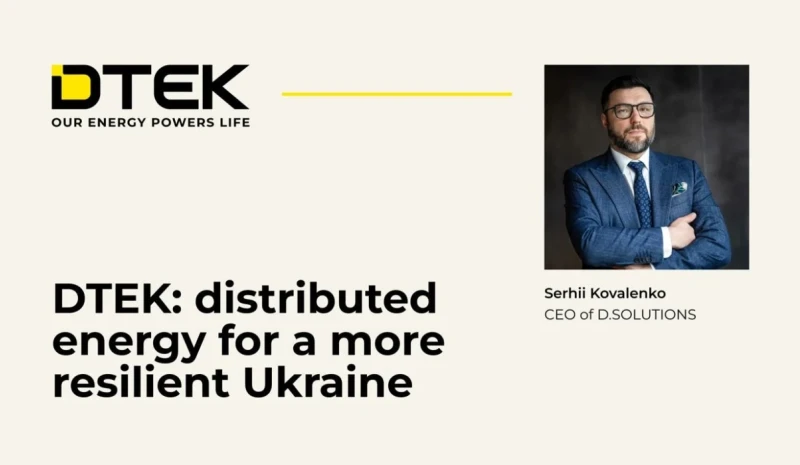
The restoration of Ukraine’s energy system after repeated large-scale attacks is no longer only the responsibility of the state or energy companies. Increasingly, businesses themselves are becoming part of the solution.
What we are seeing in Ukraine is the rapid emergence of a decentralised model and distributed energy in which part of electricity generation and storage is located closer to consumers. Globally, this transition has taken many years for many countries. In Ukraine, the war has compressed this shift into just a few years.
As a result, Ukrainian companies are not only building their own energy resilience. They are also simultaneously helping to stabilise and strengthen the entire system.
- A lesson forged under pressure
This experience matters far beyond Ukraine.
Across Europe, the United Kingdom and the United States, decentralised energy is gaining momentum, driven by climate policy, market volatility and growing need for energy security. What makes Ukraine different is the context: decisions have had to be taken under extreme uncertainty and very limited time.
Ukraine offers a real-world case study of what decentralised energy looks like when it moves from policy ambition to operational necessity.
- From “good practice” to business imperative
Just a few years ago, energy efficiency in business was often seen as a secondary issue. It was viewed more as a “good practice” rather than a management decision.
That has changed fundamentally.
Electricity is no longer a background utility. It has become a factor that directly influences a company’s financial model and ability to grow.
In the past, electricity was a simple business: there was a bill and it had to be paid. This logic works when a business is small or operating in stable conditions. But at some point, as companies scale, consumption grows, cost structures shift and exposure increases.
At that point, energy becomes more than a purely technical issue. CFOs begin to look more closely at operating costs and owners, and management considers margins and resilience with a longer-term perspective.
- Stability is no longer enough
For most companies, the first step is to seek stability: clear terms, predictable payments, minimal surprises. For some, this is enough. It is a normal, healthy model.
But for others, stability alone no longer answers critical questions:
• What happens to the business if market conditions change suddenly?
• What is the real cost of one hour of downtime?
• How can peak loads be managed?
• Could energy become a bottleneck for growth?
These questions are particularly urgent in today’s environment. This is the moment when electricity moves into the sphere of risk management.
- What energy autonomy really means
At this stage, conversations often turn to “energy efficiency” and “energy independence”. It’s important to be clear about what businesses are actually aiming for.
Most companies are not trying to disconnect from the grid. They do not need that.
What businesses want is control: a manageable share of electricity that can cover critical processes, peak periods or a share of consumption with predictable economics.
In this context, solar power plants and storage systems are no longer about “autonomy at any price”, but financial instruments for energy management.
When a business decides to install alternative energy sources, decisions are made pragmatically: based on numbers, scenarios, payback and scalability. This is why conversations about own generation increasingly take place not at the technical level, but in boardrooms involving owners and CFOs.
Energy becomes part of the business model.
- How this works in practice
Within YASNO, a DTEK brand that provides energy independence solutions for businesses, there are growing examples of how decentralised energy supports operational resilience.
One agricultural company specialising in cattle breeding installed a solar power plant to protect production during critical periods. The animals are sensitive to high temperatures, making a stable indoor microclimate critically important.
Thanks to the solar plant, the company covered around 50% of its electricity consumption during peak periods, when system load is also at its highest.
Another example is a client that installed a 62 kW solar plant to supply its office building and warehouses.
After the first year, the plant covered about 10% of annual consumption. During sunny hours, generation sometimes exceeded the company’s needs – the grid supply was stable, and excess energy was not fully used.
For this reason, the company decided to install an energy storage system – three batteries with 108 kW capacity and 215 kWh each.
This allows electricity to be stored and used later – during peak periods or outages. At the same time, the company decided to scale its solar plant.
The result is reduced electricity costs and a significantly more stable supply.
In this logic, the role of the energy partner also changes. It is no longer just a supplier of kilowatt-hours, but someone who helps a business understand where a stable supply is sufficient and where it makes sense to take the next step – to invest in its own generation or storage.
In this way, a new energy model is gradually taking shape – one in which businesses not only consume electricity but also become active participants in the system.
For Ukraine, this has another dimension.
Every new decentralised generation facility is not only an investment in a specific business. It is also a contribution to restoring and strengthening the country’s energy system.
And this is where the Ukrainian experience becomes relevant for international partners.
In a world where the role of local generation, energy storage and flexible consumption is growing, Ukrainian companies are already on a journey that many markets are only beginning: integrating generation, storage and energy management into a single business model.
When electricity determines the pace of development, the scale of risks or the cost of growth, energy independence and resilience become part of strategic choice. And more businesses are making this choice today.
The demand for decentralised generation in Ukraine has already formed and continues to grow. If you work in energy, infrastructure or finance, this is the moment to consider Ukraine as a market for partnership and investment.


DTEK Group is the largest private investor in Ukraine’s energy sector, with 55,000 employees and over €12 billion of capital invested since 2005.
Our businesses generate electricity at wind, solar, and thermal power plants; distribute and supply power to end consumers; extract natural gas and coal; trade energy resources on Ukrainian and foreign markets; and provide domestic and commercial energy services.
Over the last 20 years, DTEK has grown into a national energy leader and is today transforming into a pan-European clean energy business.
Since the full-scale invasion of Ukraine in 2022, DTEK Group has restored power to more than 26 million consumers in regions affected by hostilities.
DTEK Group is 100% owned by SCM Holdings. The ultimate beneficiary and sole shareholder is Rinat Akhmetov, a businessman and philanthropist.
All news
All news

17 June 2026
DTEK worker killed in russian strike on thermal power plant
05 June 2026
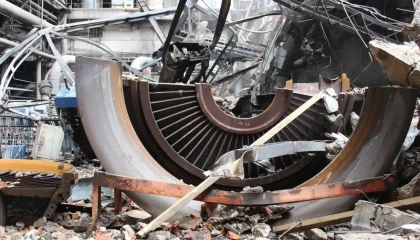
DTEK power station badly damaged in russian drone attack
05 June 2026
russia kills DTEK energy worker as he travels to work in frontline region
03 June 2026
DTEK unveils Ukraine’s first job-matching tool for veterans with disabilities in ...
02 June 2026
Two DTEK engineers wounded as russian strike knocks out power to 140,000 Kyiv ...
22 May 2026
Ukraine’s Usyk backs energy recovery, meets workers in Cairo before May 23 fight

