EN
UA


Since the company’s founding 20 years ago, DTEK has grown into a national energy leader. Today we are transforming into a pan-European clean energy business.


Our businesses generate electricity at wind, solar and thermal power plants, distribute and supply electricity to end consumers, extract natural gas and mine coal, trade energy resources on Ukrainian and foreign markets, and provide domestic and commercial energy services.
.png_230_orig_resized_500_280_2.webp)
The green transition is profoundly transforming the global energy landscape, and DTEK is embracing this revolution.

DTEK is investing heavily in implementing innovative technologies, establishing new businesses, shaping new capacities, and enhancing the production process.

The latest company updates, press releases, and news, alongside expert insights from DTEK’s leadership.

A career at DTEK means playing an integral role in driving innovative changes and developments in Ukraine’s energy sector.

Help Ukraine now, and it could power Europe later
12 May 2022, Ukraine
Copy link
Copied!

Subscribe to our news

It’s time to admit that the European Union’s (EU) energy security system has failed. Since Russia’s brazen invasion of Ukraine, member states have paid around one billion dollars per day for Russian energy—effectively financing the killing of Ukrainians and possibly fueling a wider war in Europe.
Weaning the continent off Russian gas and oil is perfectly doable. The European Commission has already said the bloc can replace one hundred billion cubic meters of Russian gas by the end of the year—nearly 70 percent of all its imports come from Russia—and, according to Greenpeace, could theoretically cut Russian oil imports by 28 percent immediately if it takes the right measures.
But as the head of Ukraine’s largest private energy provider, I’ve seen how Ukraine itself can play a vital role in a new European energy security system.
After Norway, it has the largest gas deposits in Europe and was producing almost twenty billion cubic meters of gas a year before the war. That figure is expected to grow by one-third within the next three years, according to estimates from my company, DTEK. The EU could also make use of Ukraine’s underground natural-gas storage facilities for its plans to form a strategic gas reserve (which would also allow it to join the EU’s common gas market and increase its own energy security).
Ukraine has much to offer in terms of electricity, too. After being connected to the European energy grid in March—a task long in the making, but which accelerated amid the war—the country is already in the position to export up to 1.5 gigawatts of electricity to the EU. We estimate that amount could increase to 3-4 gigawatts within a year if the grid’s power stability is properly ensured. Energy storage systems, which my company has explored, could play a vital role in this area.
Also important for Europe’s clean-energy revolution: Around 55 percent of Ukraine’s electricity is produced by nuclear power plants, while the country generates around 12 percent from renewable energy such as solar and wind farms. Industry insiders say Ukraine’s vast, windswept terrain is a strong asset for wind energy.
But the full integration of my country into Europe will require something of a “Ukrainian Marshall Plan” aimed at rebuilding Ukraine with an eye toward long-term economic stability—and energy should be one of its priorities. This will be beneficial not only for Ukraine, but for all of Europe.
Here are four key points such a plan must tackle to help boost Ukraine’s already promising energy sector:
- The first phase should begin immediately and include preparations for reconstruction as soon as hostilities end. The original Marshall Plan for post-war Europe was announced only in 1947 and launched a year later—three full years after peace was won on the continent. Neither Europe nor Ukraine can afford to wait that long to start establishing energy security.
- Implementation would also require robust institutional and human capacity. That means overseeing the stable and reliable handling of recovery funds, as well as assisting in the successful conclusion of anti-corruption reform in Ukraine (which would boost transparency and maximize efficiency). I believe this is a crucial point for a trustworthy relationship between the EU and Ukraine.
- The private sector will play a vital role in reconstruction, so creating transparent market conditions by continuing the liberalization of the energy market will be the key to attracting investment in the energy sector. Today, the private sector has turned into the driver of change and development, and a business environment based solidly on market economy principles is the foundation for rapid recovery and forward-thinking innovation in Ukraine.
- Reinvent, not restore: Renewables, hydrogen technologies, small modular reactors, smart grids, and other innovative projects will be able to replace and strengthen the energy sector of Ukraine and, consequently, the EU. The plan should become a roadmap for implementing new technologies—perhaps even some experimental ones—and creating new business models based on those. There is no need to rebuild what has been destroyed; we may be able to build the future of our dreams.
Russian President Vladimir Putin is using energy as a weapon to blackmail much of the world. Cutting off his primary source of finance—and instead buying energy from Ukraine—will not only hamstring the Russian military, but also help rebuild a peaceful country that would embrace European values and contribute to Europe’s long-term energy security.


DTEK Group is the largest private investor in Ukraine’s energy sector, with 55,000 employees and over €12 billion of capital invested since 2005.
Our businesses generate electricity at wind, solar and thermal power plants; distribute and supply power to end consumers; extract natural gas and coal; trade energy resources on Ukrainian and foreign markets; and provide domestic and commercial energy services.
Over the last 20 years, DTEK has grown into a national energy leader and is today transforming into a pan-European clean energy business.
Since the full-scale invasion of Ukraine in 2022, DTEK Group has restored power to millions of consumers across regions affected by hostilities.
DTEK Group is 100% owned by SCM Holdings. The ultimate beneficiary and sole shareholder is Rinat Akhmetov, a businessman and philanthropist.
All news
All news

20 October 2026
Five DTEK facilities hit in one day as russian attacks target power distribution ...
16 October 2026
DTEK energy facility in Odesa region damaged in overnight russian attack
12 October 2026
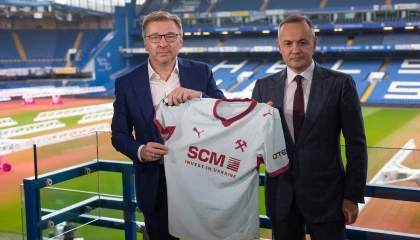
DTEK and Shakhtar launch Champions League campaign to drive investment in Ukraine
09 October 2026
russian drones hit two DTEK power sites in eastern Ukraine within 10 hours
09 October 2026
DTEK Group | 2026 September highlights
02 October 2026
US-backed investment fund introduces financing for DTEK’s landmark battery ...

